Tag Archives for Business plan

Cronto makes a sale

Thin Air At Over The AirImage by Rija 2.0 via Flickr

I first met Igor and Elena, the Cambridge, UK, based husband and wife team that runs Cronto (simple strong security), a couple of years ago when they first started working on their new encryption service.  It is a very simple idea and relies on people keeping their mobile phones handy.  Apparently they are rarely more that two metres from us!  When you access your bank account, a pattern appears on a screen, which you photograph with your mobile phone.   The Cronto software decodes the pattern and you key in the code; very simple and very secure.

It always amazed me that you could travel and access your bank account without informing the bank that you were away from home.  With Cronto,  you feel your bank account is safe.

Looking at the website, there is no sign of a VC and so I wonder what business plan resource they are using?  As they are based in the University of Cambridge’s William Gates Building, do Cambridge Enterprise have any involvement?

The website is very busy and Grant Dain, internet marketing Cambridge, might suggest that it is simplified with clearer calls to action.

Reblog this post [with Zemanta]

Plan to have no truck with late payers and work bl**dy hard!

Image via Wikipedia

Andrew McTear, founder and partner of fast growing business rescue and insolvency experts McTear Williams & Wood, has six top tips for surviving the credit crunch:

– prepare or update your business plan

– maintain up to date management information

–  cut costs as soon as you can

– focus on cashflowAlan Woodall of

– check your terms of trade

– take your chance and register on IP-Bid.com to add customers, key personnel and other assets.

All this is reinforced by Alan Woodall, self-proclaimed “gdb (general dogsbody)” and managing director of Bird’s, a Birmingham based haulage firm with 126 vehicles.  Bird’s owns all it’s depots and vehicles and has no borrowings or overdraft.  Woodhall says watch outstanding bills and keep talking to customers.

You certainly do not want to end up like the the receiver of Boringham Hall near Plymouth.  He took eleven years to sort out the receivership as the bank had a charge over the property and investors in the limited company which owned the Hall had personally bought all the furniture and fittings.   As ever, only the legal types were the winners.

Richard May, owner of private language school English in Chester has been through a few recessions and says deliver quality to your customers and work bl**dy hard – “I certainly remember the very, very long hours that we put into it (in the last recession)”.

Reblog this post [with Zemanta]

Gower Brothers of Jagex

Great St Mary's Church marks the centre of Cam...Image via WikipediaThe Gower brothers have not made much of a splash on the Cambridge Cluster scene but have quietly built up Jagex and the RuneScape game into a £200million business with reports saying that the brothers still own 52% of Jagex with Andrew Gower owning 38.5%.

Andrew has been building games virtually since coming into this world in 1978 but he had to wait until 2001 until he came up with the idea of RuneScape.  It was re-launched in 2004, after a re-write of the code, presumable to help the servers cope with the millions of users.

According to their website, Jagex has some 5.4million players active in the last two weeks.  If the subscription is some £5 per month that adds up to quite an income – no wonder they have been voted as one of the top 100 places to work.  Do they have “Google style” offices and perks such as top chefs, I wonder?

I cannot find much corporate information on the site but it says that Geoff Iddison, the former European CEO of PayPal, joined the company as CEO in October 2007   Was this there “Ed Schmidt moment” but without the back-up of the Google VCs?  There is an interesting interview with Geoff by Matt Martin.  Pity it is not a video interview as they use on the Huffington Post or Huffpo as Fred Wilson calls it. Do I need to buy and use an HD video camera?

No details on funding and I guess that they were funded by themselves from the income generated by the earlier games.  In which case why do the brothers “only” own 52% of the business? Were there any VCs or angels investors?  Did they use a business plan resource or did they just put in the “sweat” hours?

I hope that someone can persuade them to talk in the Cambridge Cluster soon.  But as I have said before, there seems to be an inverse relationship between the “talkers” and the “doers”.  Zemanta does not find much on Jagex so here is a picture of the heart of Cambridge which was covered in binary numbers last night.  It is about time we had a science and technology museum at the heart of Cambridge.

Somewhere on a dusty shelf in Cambridge is the tube JJ Thompson used to “see” electrons – really the first TV.  How many people know that Cambridge Cluster companies ARM and CSR power most mobile phones?  If the Gower brothers sell up and cannot find a college which needs a donation and a new name, how about The Gower Science and Technology Museum in a new wing of the Fitzwilliam Museum?

………………….

Much more detail on the comments and thanks for the help.  Why did the Gowers go to New York for funding when we have Amadeus in Cambridge and Index Ventures in London?  Geneva Technology also went to New York for funding and let us hope that Jagex does as well for the Cambridge Cluster and all who work here.

Reblog this post [with Zemanta]

Fudges need a skirt!

A heavily iced Christmas cakeImage via WikipediaDriving back from Cornwall, I called in at the farm shop on the Cambridge Road, just north of Royston.  The prices are not exactly Aldi but the goods are of high quality and the staff welcoming.  The cafe was busy with ladies enjoying afternoon tea and the wrinklies spending their time looking for bargains.

I found mine; a half-price Fudges Christmas Cake (nb the picture on the right is from Zemanta and is not the cake under post) reduced from £15.50 to a price competing with the other fruit cakes on offer.  The cake comes in a lovely box and I enjoyed reading the label about Percy Fudge who opened his first craft bakery in the heart of rural Dorset in 1926.

A couple of hungry friends came round to welcome me back to Cambridge and looked longingly at the cake.  I was surprised when I managed to extract it from the box to find that the icing and almond mix just covered the top leaving a very bare side.  Perhaps they should either finish the side or provide a “skirt” to show off the cake.  It needed a strong arm and a sharp knife to cut through the top layer of icing.  The cake tasted good as do so many products from members of Taste of the West, who Champion the South West’s exceptional food identity.  I wish the PR was as good as the food; what does food identity mean?  Why not The best food from Cornwall, Devon and Dorset.  The Taste of the West needs to take a look at the Huffington Post website and start using video.

At least the Fudges’ website does not have any flash and is clear and informative although aimed at wholesalers.  Of the four directors, three are Fudges and the fourth, Brent Giles.  Did Brent marry a daughter or is he an outsider?  Is he a shareholder?The site says that the company is still owned by the Fudge family and it would be interesting to learn what business plan resource they have used to plan to keep ownership in the family.

Reblog this post [with Zemanta]

Selling at the top.

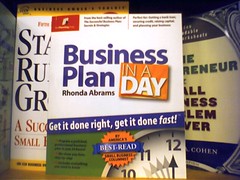
Business Plan in a Day bookImage by Raymond Yee via FlickrLawrence Bailey of Price Bailey in Cambridge has some good comments to make about selling companies.  There is a feature in a Cambridge Evening News supplement sponsored by his firm.  He talks about four different scenarios but the one I like talks about the sale of an Internet based insurance intermediary in January of this year, 2008.

At the time, the entrepreneur felt that the time was not right and the price was too low.  Nearly twelve months on, the same person reckons the company would be worth on third of the price.  Most companies plod along working away and not keeping any eye on the value of their business.  It is understandable as it is hard making a crust.  But every company should have a business plan resource which makes them track the valuation of their company and also makes sure that it is always optimised for sale.

Twenty years ago, one entrepreneur summed it up with the phrase “We could work for another ten years and not be as well off!”.  So keep one eye on the inside and the other on the outside.  But gosh, you have to be clever to close before a market stalls – and very brave! And to have Price Bailey holding your hand!

Reblog this post [with Zemanta]

No way to prepare for CEC9

Richmond club mascot, Tiger Image via Wikipedia I have been searching the CEC9 website for a list of the “Tiger” companies which will be on show but could not find any details.

TechCrunch had a list and so did Demo.  Scoble got into trouble for commenting on their websites.

Yammer won at TechCruch.

But then Scoble makes the point that some companies just concentrate on getting customers and miss out on the shows.  iLike (30millin users) and  PosiMotion (50,000 downloads a day to iPhones, most of which earn a fee) are tigers which just concentrate on customer engagement and keep their Equity Fingerprint’s and business plan, nice and simple.

So where will the Tigers at CEC9 go?  Hope that they not extinct by next year!

Reblog this post [with Zemanta]

Should I invest in A and/or B and/or C?

Dinner with Italian angels delegation-1Image by BAIA via Flickr Not able to identify the companies as they are all fund-raising at present, all on their second or third round.  It is not easy being a founder of an Active Equity Company nor being an angel investor as I hope that this post demonstrates.

We brave angels plunged into company A to prove a new idea.  Let us be clear, this idea may or may not work so we were taking an almighty risk.  The demo works but the idea can only be funded by people from the East and by governments seeking to attract new technologies.  The initial offer gives the angels a cap of 4 times our investment and then the founders and the new investors get the rest.  After much bad-tempered negotiations by e-mail, the good chair does no “do” phone calls, an offer was made to let us stay in with no limit to the upside.  Would you have taken up the offer to invest more funds?

Company B had a great start and raised millions but then the two experienced founders fell out and one left after considerable legal costs funded by the shareholders.  From the original business plan, company B should be minting money and everyone should be looking to pick up bargains in the property market.  With no warning, I return from the wedding celebrations (ps five days is too long) to receive documents saying that the company is running out of cash and is seeking to raise so much cash with a minimum of X.  My share will be such and such – but is that to meet the minimum or the maximum.  In the small print, it mentions that this round is at a discount of 50% to the previous round; lucky I did not invest in that round!  Perhaps we need a new chair to bring some fresh ideas to the table but will the old chair cancel his options and walk away?  If not, perhaps I should walk away again.

Last but not least is the very differnt company C. You can phone the office late on Saturday afternoon, recieve a warm welcome, gratitude for some suggestions and real appreciation that you are involved – so different from A and B who fight any ideas.  This time the pre-money valuation has increased four times and the issue is informally underwritten by people anxious to join the part.  One interesting matter is that because the initial round was at a generous valuation, the founders still own a good percentage of the business and so are eligible but unable to subscribe for their part of the new issue.  But existing shareholders have first call on the issue and so can increase their holding in the company.  So it is not just a question of keeping up but of jumping up the equity holding.  And the person on charge finds time to charm minnow investors.  Imagine what he will do to customers of the product and of the company.

But then that is probably why companies A and B are struggling.

Now all I need to do is to work out the Equity Fingerprints, the business plan resource, of each company to make an informed decision.

Reblog this post [with Zemanta]

Samantha Sharpe is the NESTA Innovation Policy and Research Fellow

The Judge Business SchoolImage via WikipediaDr Samantha Sharpe is part of the team at the Centre for Business Research, Judge Business School, University of Cambridge studying early stage companies.  She is funded by NESTA and has a project in the same area as the NESTA project using Equity Fingerprint, the business plan resource.

In  her talk at a meeting at Lancster University Management School (when will it be re-named Lancaster Business School?), Samanthan outlined her work on researching the portfolio of investments made by the N W Brown Group, now IQ Capital Partners.  She has been allowed acess to all the confidential information and so is only able to produce summaries of her data.  Most interesting was a graph which related to Equity Fingerprint.  But whilst Equity Fingerprint concentrates on the decisions made by entrepreneurs in raising fund and how it impacts on their ownership of the company, Samantha’s graph showed the total funing of each round from equity, loan and grants – it showed the gearing achieved by the entrepreneurs on the funds raised.  It would be good to incorporate a measure of the change in valuation at each stage.  I also suggested that she showed the number of founders at each round as it appears that most Active Equity Companies have three or more founderswhich is very different from Passive Equity Companies which have fewer than three founders.

Of course the sample reflects the types of team which will approach a relatively small player in theUK funding and not the entrepreneurs who will chose other routes such as a trade investment, angels or VCs.

Would a study across the funding groups show that entrepreneurs who take a specific route – customer funding to VC – be significantly more successful than companies following the IQ Capital Partners route or taking investment from Cambridge Enterprise?  Or should we stop studying and get on with building business?

Zemanta Pixie

Goodbye to Captain Arthur Jarman and hello Bare Necessities

Burj al Arab Hotel in DubaiImage via WikipediaLymington was the UK base for Captain Arthur Jarman who died earlier this year after 90 busy years in Africa and finally as a port captain in Dubai.  A fine man missed by all the young (although not so young now) he had always helped.

Cpt Jarman would have enjoyed a day at the helm of The Bare Necessities and this has nothing to do with lingerie!  Bare Necessities is for the successful entrepreneur who has played his Equity Fingerprint, the business plan resource, right and is now looking for fun.  The 82′ yacht is available for charter and prices start at some £4,000 per day.  You can take nearly twenty friends and the crew of four all bunker down ahead of the mast so no mixing!  It would be good for geeks as there are 17 computers feeding 20 LCDs.  You can pull on the sheets or let the crew take the strain.

Zemanta Pixie

Edwards Heavies at Lymington with knickers by the sea

The town quayImage via WikipediaSpending a few days at Lymington and looking for Active Equity Companies to see if there are any interesting Equity Fingerprints, the business plan resource.  All I could find was some interesting family companies.

Edwards Heavies was started in the late 80s and sells rugby jerseys to the yachting crowd of Lymington.  Lymington was a peaceful little backwater until found by the Londoners and now all the second homes fill up at the weekends and in the summer.  But the Internet has transformed Edwards and instead of one small shop, Edwards has a flourishing web business.

Annable Gatward has established Glamorous Amorous in Lymington to sell designer lingerie from a long list of young designersShe spent £65,000 setting up the business and turnover is forecast at£200,000 this year.  All sales are on the Internet.

Perhaps Edwards and Glamorous Amorous will join up one day to rationalise on web and overhead costs but will remain Passive Equity Companies.

Reblog this post [with Zemanta]